Airs, Waters, Places: Hippocrates on Climate and Character
A Greek physician was told to study a town's winds and water before he treated anyone in it. Airs, Waters, Places is the oldest surviving argument that place shapes character, and the source of two thousand years of prejudice about it.
A Greek physician arriving in an unfamiliar town near the end of the fifth century BC was told to do nothing medical at first. Before he opened his bag he was to learn which way the town faced, which winds reached it, and where its water came from. The instruction comes from Airs, Waters, Places, a short treatise gathered under the name of Hippocrates. It is the oldest surviving attempt to explain a whole people's character by the place they live in.
Whoever wishes to investigate medicine properly, should proceed thus: in the first place to consider the seasons of the year, and what effects each of them produces.
The survey a stranger was told to make
The list is meant to be walked. Note the seasons and what each one does. Note the winds, the ones every country gets and the ones peculiar to this valley. Note the waters: marshy and soft, hard off the rock, or salt. Note how people pass the day, whether they drink heavily, sit still, or work outdoors. It is a physician without a laboratory doing the only epidemiology open to him: looking.
Towns that face the wrong way
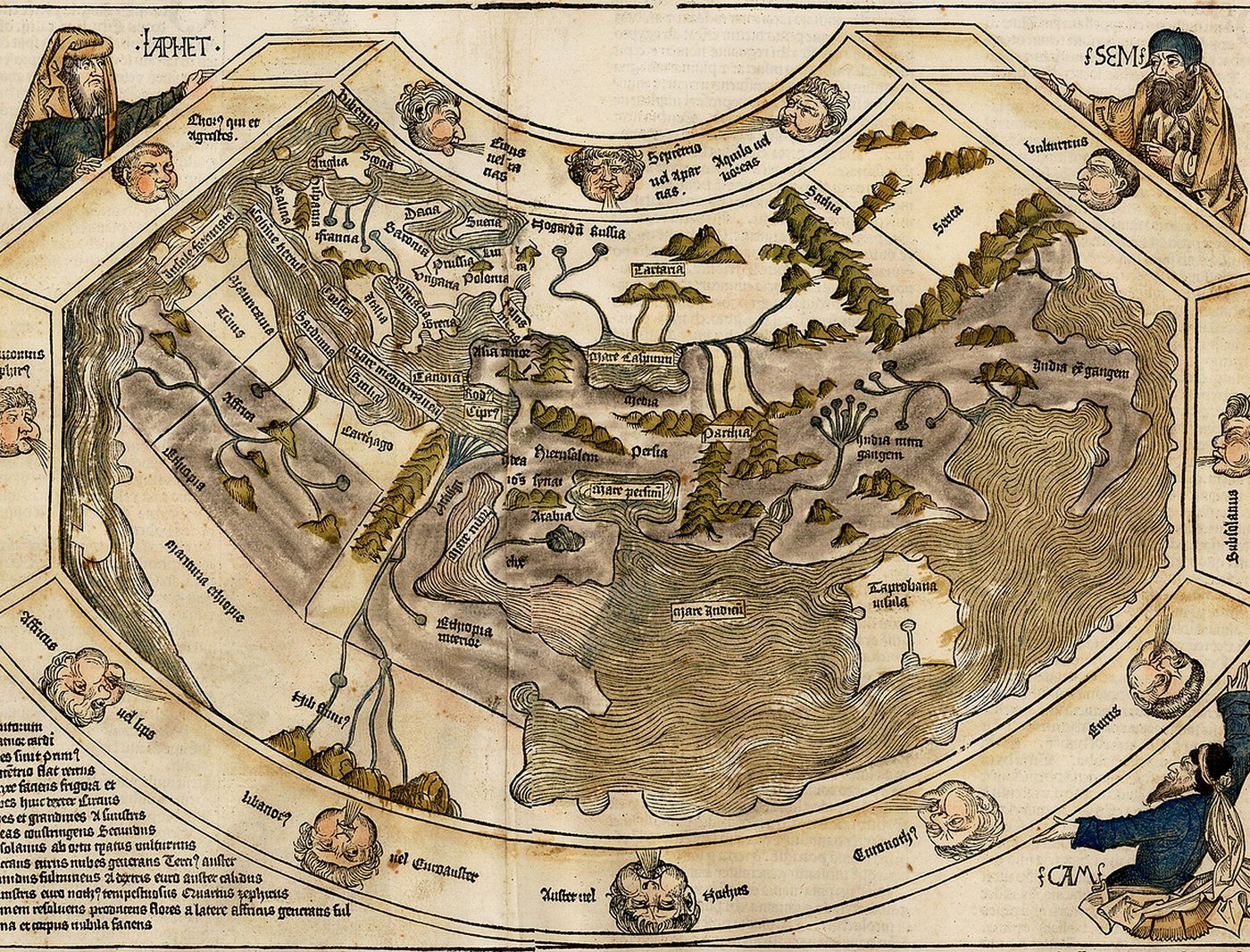
The treatise is most confident about wind. A town open to the hot southern winds and sheltered from the north has brackish water near the surface, warm in summer and too cold in winter. The heads of its people are moist and full of phlegm, their digestion disturbed by what runs down from above, and the men are prone to dysentery and long slack fevers. A town facing north has hard cold water, and its people are lean and sinewy, more bilious than phlegmatic, subject to pleurisy and sharp sudden illness. Towns open to the rising sun are healthiest. Towns facing the setting sun are worst of all, misty in the morning, their inhabitants pale.
There you can watch the humors sorted by geography rather than by birth. One town is phlegmatic, the next bilious, and the cause given is the direction of the street. The reasoning that later produced the four temperaments is applied to a whole population at once.
Water, and the danger of change
Standing marsh water turns thick and foul in summer, and he blames it for swollen spleens and dropsy. Rainwater is lightest and sweetest but spoils fastest. Melted snow he calls simply bad, since freezing drives off the good part and leaves the heavy remainder. Seasons matter for one reason above all: change. It is not heat or cold that harms people so much as the swing between them. That instinct outlived the theory. It stands behind the later idea that a life has its own seasons, and behind the habit of reading a person as a small universe with weather of its own.
Air kept its place at the head of the list for two thousand years. When Galen and later the Arabic physicians listed the things that keep a body well or make it sick, air came first, ahead of food, sleep, exercise and the passions. Avicenna's Canon treats the air of a place as a cause of illness in its own right, not as scenery.
The half that became a weapon
Then it turns from towns to peoples, and the trouble starts. Asia, it says, has a mild and even climate, so everything grows large and gentle there, people included, without the spirit that hard seasons force out of a man. Europe, with its violent changes, breeds harder and more warlike stock. The Scythians of the steppe are cold and damp, flabby and ruddy, loosened by wet air and a life on horseback.
The author is no simple determinist. He gives law as much weight as weather, saying that men ruled by a king fight badly because they are not fighting for themselves, while men under their own laws fight well wherever they live. He also refuses a supernatural account of the impotence common among rich Scythian horsemen: it is no more god sent, he says, than any other illness.
It made no difference. This half of the text became a quarry. Jean Bodin built a climatic ranking of nations on it in the 1560s. Montesquieu gave several books of The Spirit of the Laws in 1748 to the action of hot and cold air on the fibres of the body and, from there, on liberty. By the nineteenth century the frame had hardened into race theory, the medicine stripped out and replaced with skulls.
The idea worth keeping
The error was never the observation. Places do work on people. Light, heat, altitude, water, how long the winter keeps you indoors: all of it leaves marks, and modern medicine measures several of them.
The error was the ranking, the slide from noticing that a marshy town breeds a certain illness to grading whole nations by the wind that reaches them. That is the oldest bad habit in the study of character: take a real difference, hang a hierarchy on it.
So keep the usable part small and local. Your work, your sleep, the light you get, the winter you sit through: all of it shapes how you tend to react, and none of it is fixed forever. Worth remembering when you take the test and read the result. Nobody is a climate. But nobody lives outside one either.
Find your temperament
Take the test