The Zodiac Man and Your Temperament
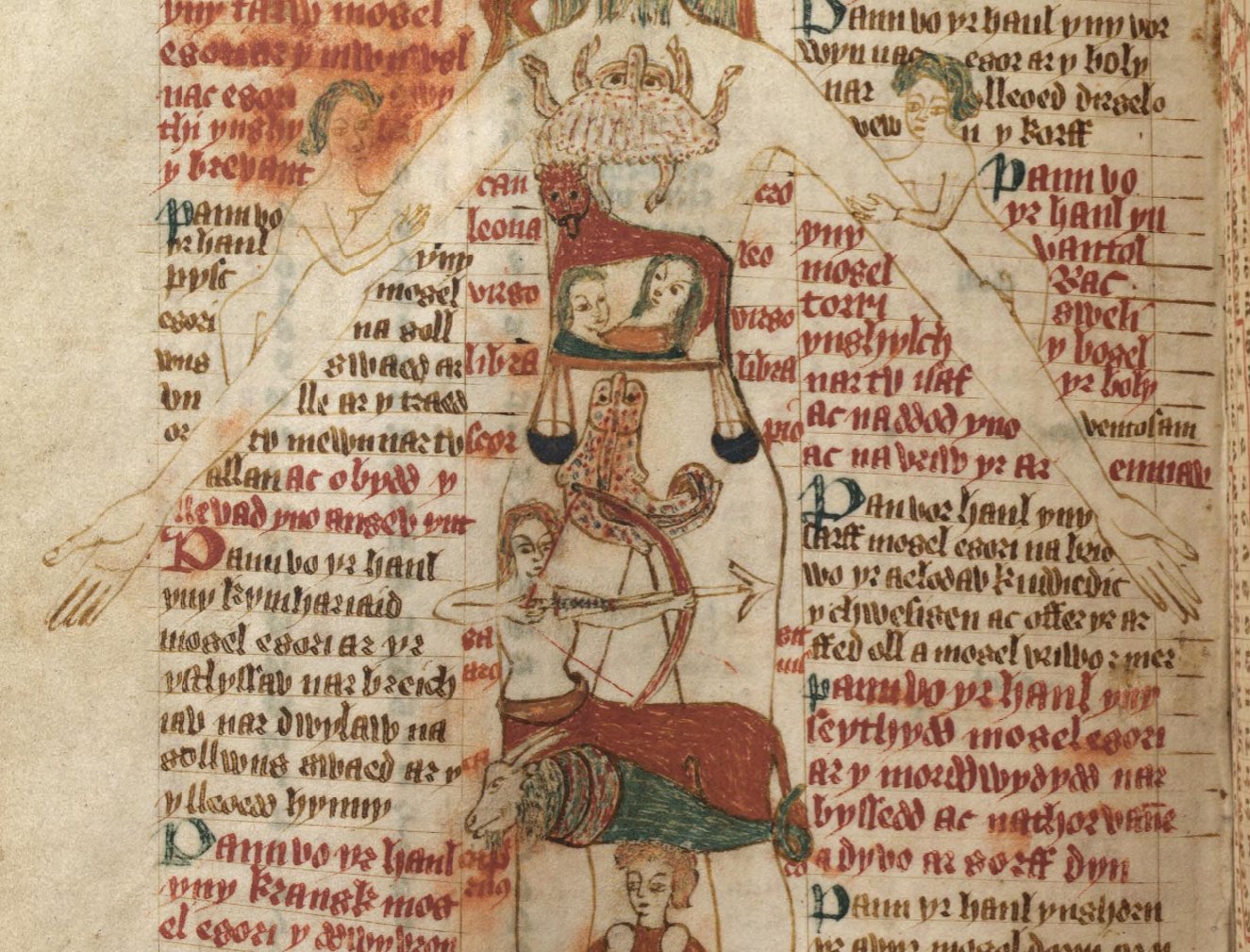
For centuries, medicine and astrology were a single craft. The zodiac man ruled the body from Aries at the head to Pisces at the feet, and the twelve signs fell into the same four elements as the temperaments.
In 1348, with the plague loose in Europe, the king of France asked the medical faculty at Paris to explain it. The scholars answered with the sky. The sickness, they wrote, had begun with a conjunction of Saturn, Jupiter, and Mars that gathered a few years earlier, in 1345. A bad meeting of planets overhead had corrupted the air below.
The answer sounds strange now. To the men who wrote it, it was simply good medicine. For most of a thousand years, healing and star reading were one craft, learned from the same books and practiced by the same hands.
The man made of signs
Turn the page of almost any late medieval almanac and you meet him: a bare figure standing with his arms held a little out from his sides, twelve signs of the zodiac laid across his body like a second skin. Physicians called him homo signorum, the man of signs. We call him the zodiac man.
The order ran from the top down. Aries ruled the head, Taurus the neck and throat, Gemini the shoulders and arms. Cancer sat over the chest, Leo the heart, Virgo the belly. Libra governed the loins, Scorpio the groin, Sagittarius the thighs, Capricorn the knees, Aquarius the shins, and Pisces, at the very bottom, the feet. Head to foot, Aries to Pisces, the whole zodiac mapped onto one body.
This was not a chart of who you were. It was a chart of where, and when, a doctor could safely cut.
Waiting on the moon
Bloodletting was the everyday tool of medieval medicine, and it came with a rule. You did not open a vein in a part of the body while the moon stood in the sign that ruled it. Moon in Aries, leave the head alone. Moon in Pisces, keep the blade from the feet. The same caution held for cautery and the surgeon's knife.
So physicians and barber-surgeons carried folding almanacs, little books worn on the belt, that gave the moon's sign for every day of the year. Before a planned bleeding they checked the page the way a sailor checks a tide table. Chaucer's physician in the Canterbury Tales is drawn this way, and not as a joke: a doctor well grounded in astronomy, timing his treatments by the hour and the sign. To Chaucer's first readers, that was what a careful doctor did.
Fire, air, earth, water
Here the zodiac braided into the older scheme of the body as a small universe. The four elements had long been paired with the four humors and the four temperaments. Fire was hot and dry, the choleric. Air was hot and moist, the sanguine. Earth was cold and dry, the melancholic. Water was cold and moist, the phlegmatic.
Astrologers, going back to Ptolemy in second century Alexandria, had already sorted the twelve signs into those same four elements, three signs to each. So the two systems clicked together.
- Aries, Leo, and Sagittarius were the fiery signs, and so choleric.
- Gemini, Libra, and Aquarius were airy, and so sanguine.
- Taurus, Virgo, and Capricorn were earthy, and so melancholic.
- Cancer, Scorpio, and Pisces were watery, and so phlegmatic.
A person's birth sign, on this reasoning, leaned their nature toward one of the four humors, the same four that turned with the seasons and the ages of a life. The sign burning in the sky and the temper moving in the blood were held to be made of one element.
To time a cure by the stars was to treat the patient as part of the sky, not apart from it.
What the wonder was hiding
None of this is how a body works. The moon does not thicken the blood in your feet, and the stars do not sort people into four kinds. The chemistry was mistaken, and so was the astronomy. The physicians who trusted it were not fools. They were reasoning carefully from the best map anyone had drawn.
It helps to see what they were reaching for. They wanted one order that ran from the farthest sphere down to a cut on a patient's arm, so that nothing in a person stood outside the pattern of the world. The zodiac man was that wish drawn on a single page: a body small enough to hold in the hand, ruled corner to corner by the same signs that were said to rule the heavens.
We keep the four temperaments and let the twelve signs go. Read as warm or cool, quick or slow, outward or inward, the four types still name something you can watch in a person across a room. The elements behind them turned out to be poetry. The people they were trying to describe are still here.
Find your temperament
Take the test