The Anatomy of Melancholy: Burton's Thousand Pages of Black Bile
Robert Burton spent thirty years on a thousand pages about his own black bile, and wrote plainly that he wrote of melancholy by being busy to avoid melancholy. It is the largest book anyone produced inside the humoral system.
In the cathedral at Christ Church, Oxford, there is a monument with a painted bust of a man in academic dress and a horoscope carved above his head. The Latin beneath says that here lies Democritus Junior, known to few, to fewer unknown, to whom Melancholy gave life and death. The man was Robert Burton, a college librarian and a clergyman, who died in January 1640. The epitaph is generally thought to be his own. He had spent roughly thirty years on one book about the humor he believed was working on him from the inside.
The book that would not stop growing
The Anatomy of Melancholy was printed in Oxford in 1621, under the name Democritus Junior, with a title page promising all the kinds, causes, symptoms, prognostics and several cures of it. That first edition was already a large quarto of some nine hundred pages. Burton then enlarged it in 1624, again in 1628, again in 1632, and again in 1638. A sixth edition came out in 1651, after his death, set from the copy he had gone on annotating to the end. By then the thing ran to something like half a million words.
He did not really revise. He accumulated. Whatever he read went in: Galen and the Arabic physicians, Hippocrates, Seneca, church fathers, poets, travellers, gossip. Latin sits untranslated beside plain English. Digressions swallow chapters. The book is a mind emptying itself onto paper for three decades and refusing to stop, and the refusal is the point.
What the word meant in 1621
Burton inherited a system that was already ancient when he got it, and he did not question its frame. Melancholy was black bile, cold and dry, the humor of earth and autumn, the one that thickened and settled and made a man heavy. The history of the four humors had passed that idea through Greek, Roman, Arabic and medieval hands more or less intact, and Burton is its late, enormous English heir. He took his working definition from the tradition: a kind of dotage without a fever, having for its ordinary companions fear and sorrow, without any apparent occasion.
Fear and sorrow without a cause. That is a good sentence, and it is still recognisable. But look at what else the word had to carry. Under melancholy Burton files what we would now call anxiety, obsession, hypochondria, insomnia, lovesickness and religious despair, and also the ordinary studious tilt of the melancholic temperament, which the Aristotelian tradition had long linked with unusual ability. One word did the work of a disease, a mood, a fault and a gift.
Busy to avoid it
The preface, Democritus Junior to the Reader, is itself about a hundred pages, and it contains his most quoted admission.
I write of melancholy, by being busy to avoid melancholy.
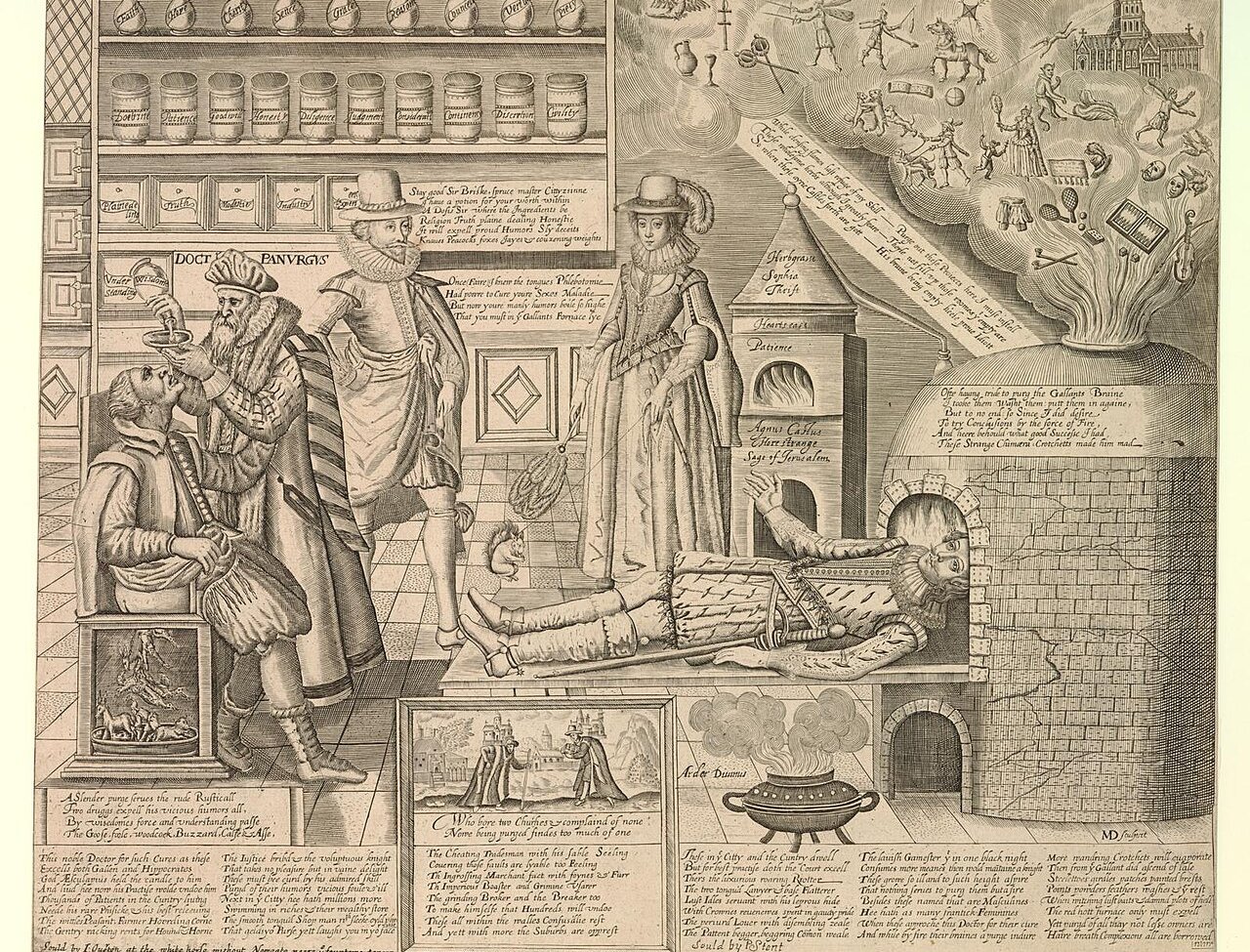
He is unembarrassed about this. He says he writes because otherwise he would be idle, and idleness was, in his own diagnosis, what let the bile settle. The second partition then lays out the cures of the day, the whole standard apparatus of how the four humors were once treated:
- correcting the air, the sleep, the diet
- exercise, travel, music, cheerful company
- purges, bleeding, and a long list of simples
- study, but not too much of it
And at the very end, after everything, comes the counsel he had really been writing toward: be not solitary, be not idle. A thousand pages that are themselves an act of not being idle, closing on the instruction not to be idle. Later readers noticed the joke, and noticed too that it was not one. Samuel Johnson, who knew the territory, said it was the only book that ever got him out of bed two hours earlier than he wanted to rise. Keats read it and came out of it with Lamia.
Where it stops being a medical book
The third partition turns to love melancholy and religious melancholy, and here Burton does something his sources did not. He treats despair, including the kind that arrives wrapped in scripture and self accusation, as a condition a physician might reasonably address rather than only a sin to be scolded. He writes about the shame of it, the sleeplessness, the dread on waking, the inability to say what is wrong when someone asks. He does not flatter the sufferer and he does not console. He keeps company.
Careful with the word depression
It is tempting to call the Anatomy the first book about depression, and the temptation is worth resisting a little. The descriptions overlap. The explanations do not. Burton accounts for the same bad afternoon by black bile, by the stars, by bad meat, by grief and by the devil, and sees no conflict in holding all of them at once. A modern diagnosis is a defined set of symptoms over a defined stretch of time, reached by criteria, and it makes no claim about earth or autumn. Reading either one straight into the other flattens both, in much the way that mapping the old temperaments onto modern personality types loses what each was built to do.
What does carry over is the attention. Burton looked steadily at his own worst hours for thirty years and wrote down what he saw, inside a system that has since been taken apart, in words that still land. The system was wrong. The looking was not.
Find your temperament
Take the test