How the Four Humors Were Once Treated
For two thousand years, a body out of balance was something to bleed, purge, or carefully manage. Here is how it was actually done, and why medicine left it behind.
The red and white pole outside an old barbershop is a small monument to bloodletting. Red for the blood, white for the bandages, and the pole itself for the staff a patient once gripped to make the veins stand up. Barbers did more than cut hair. They opened veins.
When the cure was to drain
For most of Western medical history, if a physician decided your humors had slipped out of balance, the remedy was to remove whatever you had too much of. Blood was the easiest to reach.
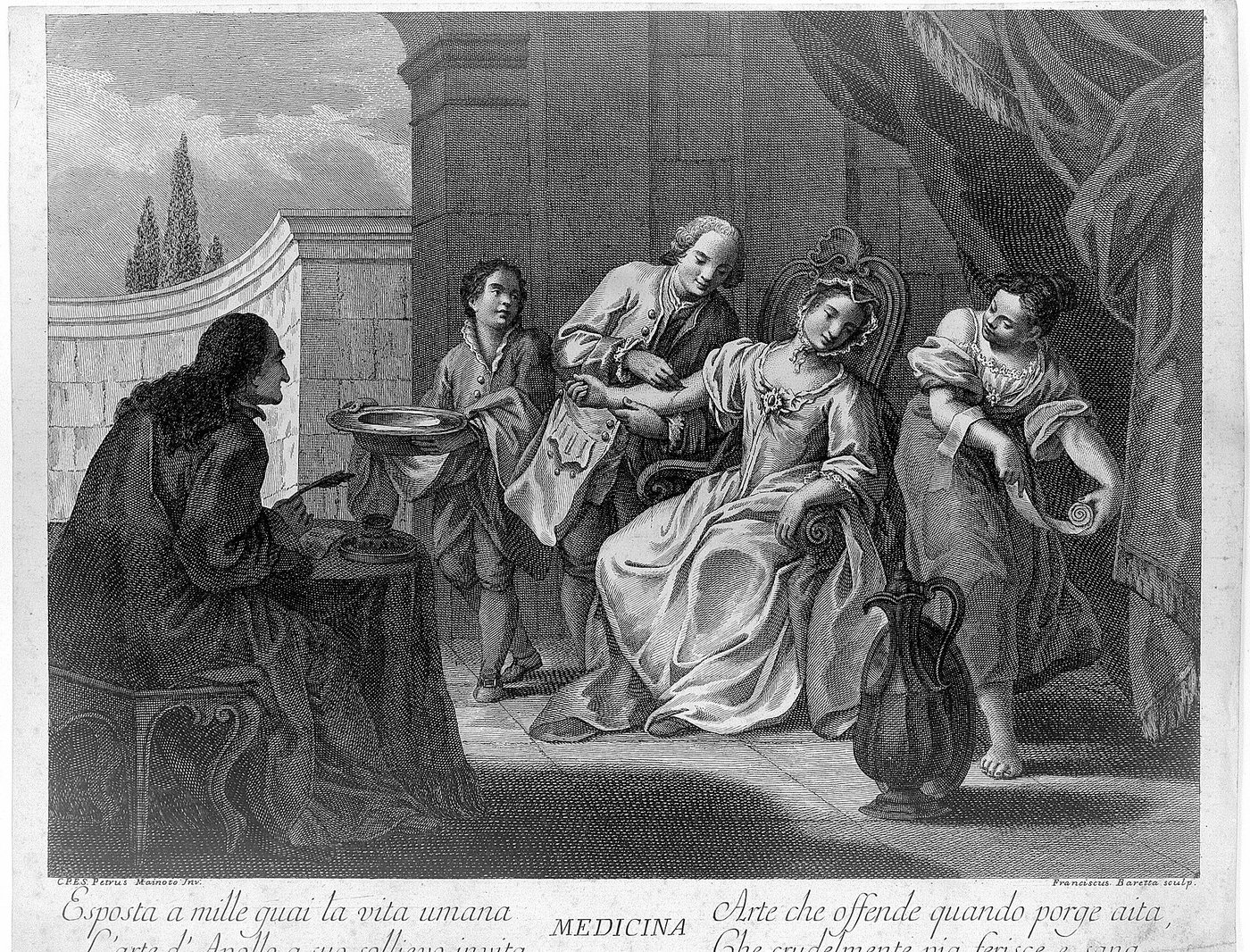
Venesection meant opening a vein, usually at the arm, and letting a measured amount run into a shallow bowl. The reasoning came straight from the theory of the four fluids, and where the humors came from is worth reading alongside this. Too much blood was thought to make you feverish and flushed, so you let some out. On its own terms it was perfectly logical.
Where a vein was awkward there were other tools. Cupping used heated glass cups set on the skin; as the trapped air cooled it drew the flesh upward, and in wet cupping small cuts let the blood seep into the cup. Then there were leeches. In early nineteenth century France the appetite for them ran so high that many millions were imported in a single year, and one Paris physician, Francois Broussais, treated almost every complaint by lining his patients with them.
Purges worked the far end of the same idea. Emetics to bring things up, remedies to move them down, others to sweat or drain the excess away. Black bile, blamed for heaviness and gloom, was chased out through the bowels. The principle never changed. Find the surplus, and get rid of it.
The quieter cure
Bleeding and purging are what people remember, but they were the loud end of the practice. Far more often a physician prescribed something gentler and much more demanding: a regimen.
Galen, working in Rome in the second century, and the doctors who followed him sorted daily life into the things a person could adjust. Later writers called them the non naturals: the air you breathed, food and drink, sleep and waking, exercise and rest, what the body took in and let go, and the motions of the emotions. Manage these for your particular nature and the humors were supposed to settle on their own.
So the advice was personal. A hot, dry, choleric man might be told to give up red meat and wine, seek cool damp air, sleep more, and rage less. A cold, damp, phlegmatic one might be pushed toward exercise, warming spices, and dry rooms. The medieval Regimen of Salerno set much of this to verse so it could be memorized, brisk little rules about when to rise and what to put on the table.
This is the part worth slowing down for. The regimen assumed your temperament was a lasting disposition, the nature you were born into, and yet not a life sentence. It could be warmed, cooled, coaxed a little toward the middle. That is close to how people still think, the quiet sense that you might whether you can really change your temperament at the edges without turning into someone else.
History, and not advice
None of this was harmless. In December 1799 George Washington woke with a savage throat infection, and over a single day his doctors drained a great deal of his blood. He died that night. Whether the bleeding killed him or merely failed to save him, it did not help.
Part of what kept the practice alive was that it was so hard to argue with from the inside. If a patient recovered, the treatment was vindicated. If not, the imbalance had simply gone too far to correct. Only in the nineteenth century, as physicians began to count outcomes rather than trust the logic, did bloodletting start to look like what it was.
Modern medicine left the humors behind for good reason, and none of the above is a suggestion. What is strange is that a few of the tools outlived the theory entirely. Surgeons still use medicinal leeches to relieve congested blood in reattached fingers and flaps of skin. Doctors still draw off blood in careful amounts for real conditions such as iron overload. The instruments survived; the reasoning is completely different.
Strip away the biology and something older remains, the same instinct that ran under all that draining and dieting. A person's nature was not a fixed weight to carry but something you could tend. The physicians were wrong about the fluids. They were onto something about the temperaments.
Find your temperament
Take the test