Food and the Four Humors: When Dinner Was Medicine
For centuries, every apple, cut of meat, and cup of wine carried a hidden nature, and eating well meant eating to keep yourself in balance.
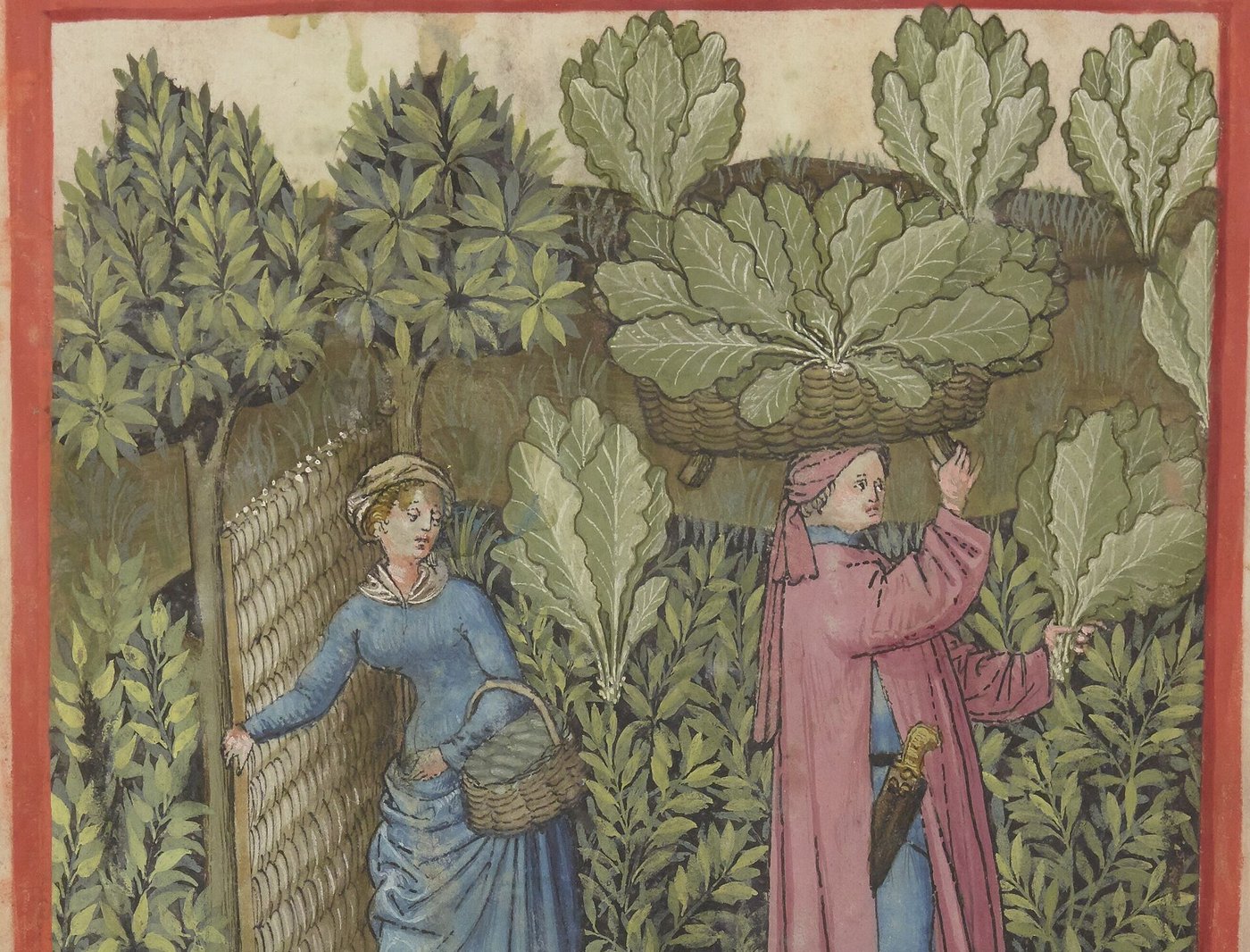
In a manuscript painted in Lombardy around the year 1400, a young woman bends into a garden bed and cuts heads of lettuce into her apron. Beside her, in a few lines of Latin, the page explains the plant: cold and moist, good for calming a hot stomach and easing sleep, a little dangerous to the eyesight, best corrected with celery. The picture is pretty. It is also a prescription.
For most of recorded history, in Europe and the Islamic world alike, food was not separate from medicine. It was the first medicine. Every apple, every cut of meat, every cup of wine carried a hidden nature, and eating well meant eating to keep yourself in balance.
Every food had a temperature
The humoral world sorted everything, dinner included, along two axes: hot or cold, wet or dry. This had nothing to do with the temperature of the plate. It described what a food was thought to do once it was inside you.
Pepper, ginger, and garlic were hot and dry. Cucumber, lettuce, and melon were cold and moist. Beef leaned dry, pork moister, fish cold and wet, honey and wine warming. Physicians even graded these in degrees, first through fourth, so that pepper might be hot in the third degree and lettuce cold in the second.
The point of all this sorting was balance. The rule, inherited from Greek medicine, was that opposites correct each other. If your nature ran hot and dry, you cooled and moistened it. If it ran cold and wet, you warmed and dried it. Food was the daily, gentle lever for doing that, which is one reason people believed a body could be nudged over the years, and why the question of whether you can change your temperament once had a practical, edible answer.
A book you could eat by
The lettuce picture comes from the Tacuinum Sanitatis, a family of lavishly illustrated health handbooks made in northern Italy in the late 1300s and 1400s. They were Latin versions of an eleventh century Arabic work, the Taqwim al-sihha, written in Baghdad by the physician Ibn Butlan.
Each entry followed the same tidy pattern. It named the item, gave its nature and degree, named the best kind to choose, listed its benefit, warned of its danger, and then told you how to cancel that danger. Melons were cooling and welcome in heat, but heavy on the stomach, so you followed them with something warming. Fresh cheese was moistening and fattening, aged cheese close to the reverse. Even sleep, spring air, and a good walk got their own pages, since staying well was never only a matter of food.
These were not dry reference books. They were closer to beautiful picture almanacs for a wealthy household, full of orchards, market stalls, and cooks at work.
Feeding a nature
Set a person's temperament beside this pantry and the advice almost writes itself.
- A hot, dry choleric was steered away from red meat, strong wine, and pepper, and toward cooling, moistening things: lettuce and cucumber, barley water, fish, fresh fruit.
- A cold, wet phlegmatic got the opposite counsel, to warm and dry a sluggish humor with roasted and spiced dishes, ginger, mustard, and a little good wine.
A melancholic, cold and dry, was thought to need warmth and moisture, gentle broths and sweet things, and to avoid the heavy, dark meats believed to feed black bile. A sanguine, already warm and moist and counted lucky for it, mostly needed to avoid excess.
Cooking changed the equation as well. Roasting made a food hotter and drier, boiling made it moister. A cold, wet fish could be corrected by frying it and dressing it with hot spices. Season mattered as much as nature. You leaned cooling in summer and warming in winter, matching the body to the year, an idea that made plain sense once you saw the body as a small universe answering to the same qualities as the seasons and the stars.
History, not a meal plan
None of this is dietary science, and it is worth saying so plainly. Lettuce does not cool a humor, because there are no humors. Black bile was never a fluid you could feed or starve.
Still, the people who ate by these rules were not foolish. They were working inside a coherent, carefully observed system, one that treated eating as care of the whole person and paid real attention to freshness, season, moderation, and the plain fact that different bodies suit different foods. Take away the vanished biology and a simple thought is left standing: what you eat changes how you feel. They only drew the map differently than we do.
Balance was something you could taste, one careful plate at a time.
Find your temperament
Take the test