Hildegard of Bingen and the Four Humors
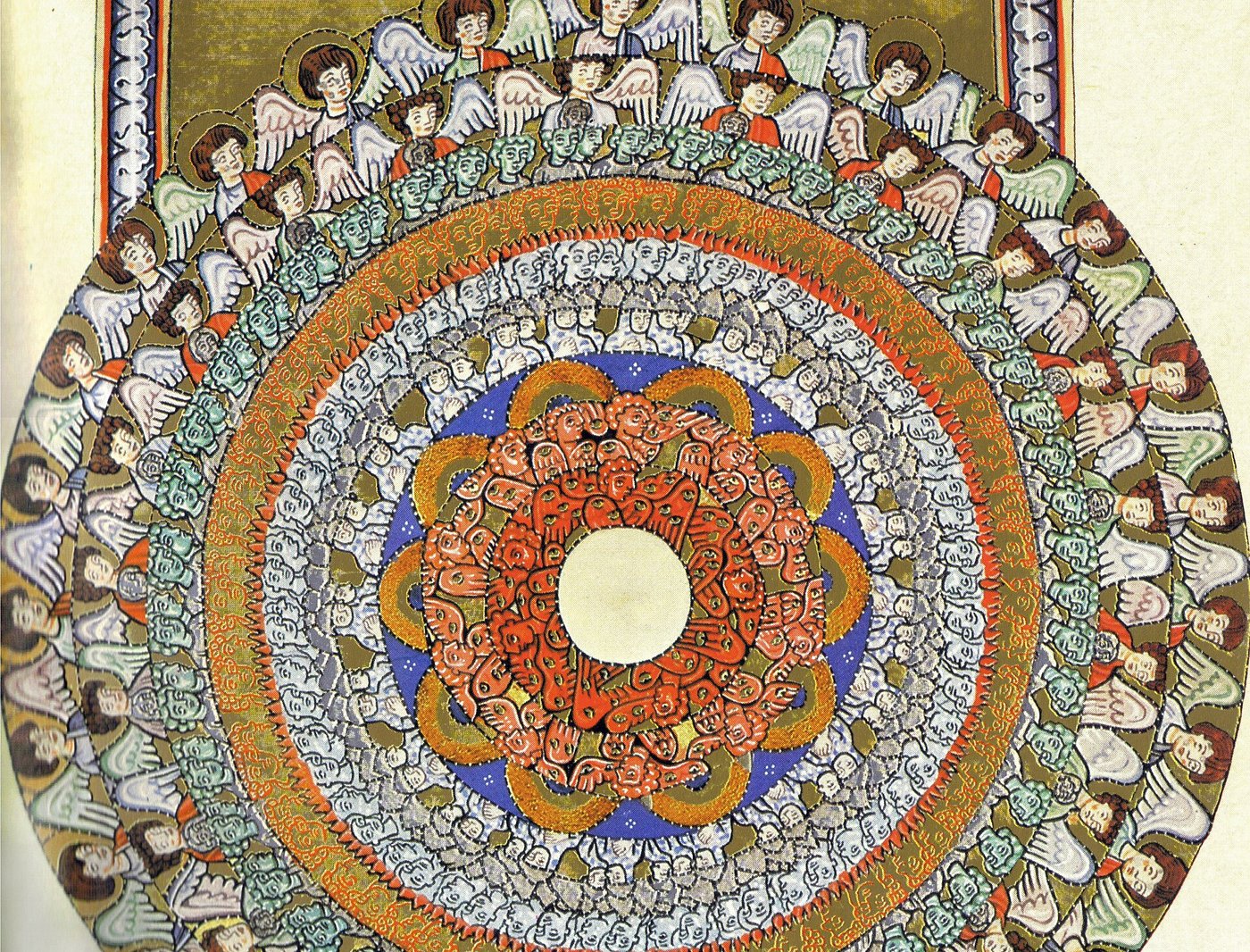
One of the few women whose scientific voice survives from the twelfth century, Hildegard of Bingen wrote about the four humors and bound them to her own greening vision of body, soul, and world.
On the hills above the Rhine, near the town of Bingen, a Benedictine abbess spent her later years writing about the human body. Her name was Hildegard. She was born in 1098 in the German Rhineland, and by the time she died in 1179 she had composed music that is still performed, corresponded with popes and an emperor, founded two convents, and recorded visions that made her famous across Europe.
Less known is that she also wrote about medicine. In two works, Physica and Causae et Curae, both from around the middle of the twelfth century, she set down what she understood about plants, stones, animals, illness, and the four humors.
An abbess among physicians
Hildegard was given to the Church as a girl, raised from about the age of eight by an anchoress named Jutta at the monastery of Disibodenberg. She grew into the leader of the women there, and around 1150 she moved her community to a new house at Rupertsberg, near Bingen, later founding a second across the river at Eibingen.
She was never a university physician. Women were largely shut out of the schools then taking shape, and her knowledge came instead from the monastic infirmary, the herb garden, the daily care of the sick, and the books a learned convent could hold.
The framework she inherited was already old. The story of where the four humors began belongs to the Greeks: blood, yellow bile, black bile, and phlegm, each warm or cold, moist or dry, with health resting on a balance among them. Hildegard took this map and drew on it in her own hand.
The humors in her own words
She kept the four fluids but described them in her own vocabulary, and she wove human character into the scheme much as Galen had, sketching four kinds of constitution according to which humor ran strongest in a person. A blood-rich person was one thing, a bile-heavy person another.
Her version does not line up neatly with the tidy labels of sanguine, choleric, melancholic, and phlegmatic that later writers polished. She described men and women differently, tied temperament to the whole life of body and soul, and read a person's makeup in their color, their moods, their appetites, their sleep. Where a modern chart wants four clean boxes, she saw shadings.
Much of her writing is practical: what herb cools a fever, what food suits a heavy stomach, how to steady a restless mind. It is the medicine of a working infirmary, not a lecture hall.
Viriditas, the greening power
Her most distinctive idea has no exact English name. She called it viriditas, a greening or greenness, the moist living force that pushes sap up a stem, reddens fruit, and keeps a body warm and whole. A blooming meadow had it. So did a healthy person and a soul in grace. When it drained away, dryness and decay set in.
For Hildegard the body was a small version of the wider world, bound to the turning of the year and the order of the heavens. This is why her medicine reads as one piece with her theology: flesh, spirit, and cosmos were a single fabric, greening or fading together. You can hear an echo of it in the older idea that temperament runs through the seasons and ages, warm and moist in youth, cold and dry toward the end.
A greening world and a healthy body, in her vision, were the same thought said twice.
History, not a prescription
None of this is modern medicine. We no longer treat a fever by balancing bile, and the links medieval writers drew between humors, planets, and character belong to history rather than the clinic. But the people who believed these things were not fools. They were reading the body with the best tools they had, and reading it with care.
What makes Hildegard rare is that we can hear her at all. Almost every voice that reaches us from twelfth-century science is a man's. Hers is a woman's, confident and strange and entirely her own. The Church took a long time to say so plainly. Only in 2012 was she named a Doctor of the Church, more than eight hundred years after she laid down her pen above the Rhine.
Find your temperament
Take the test